

Impact in Motion: Social Sciences Impact Conference 2026 explores how social sciences can drive change in uncertain times
1 April 2026
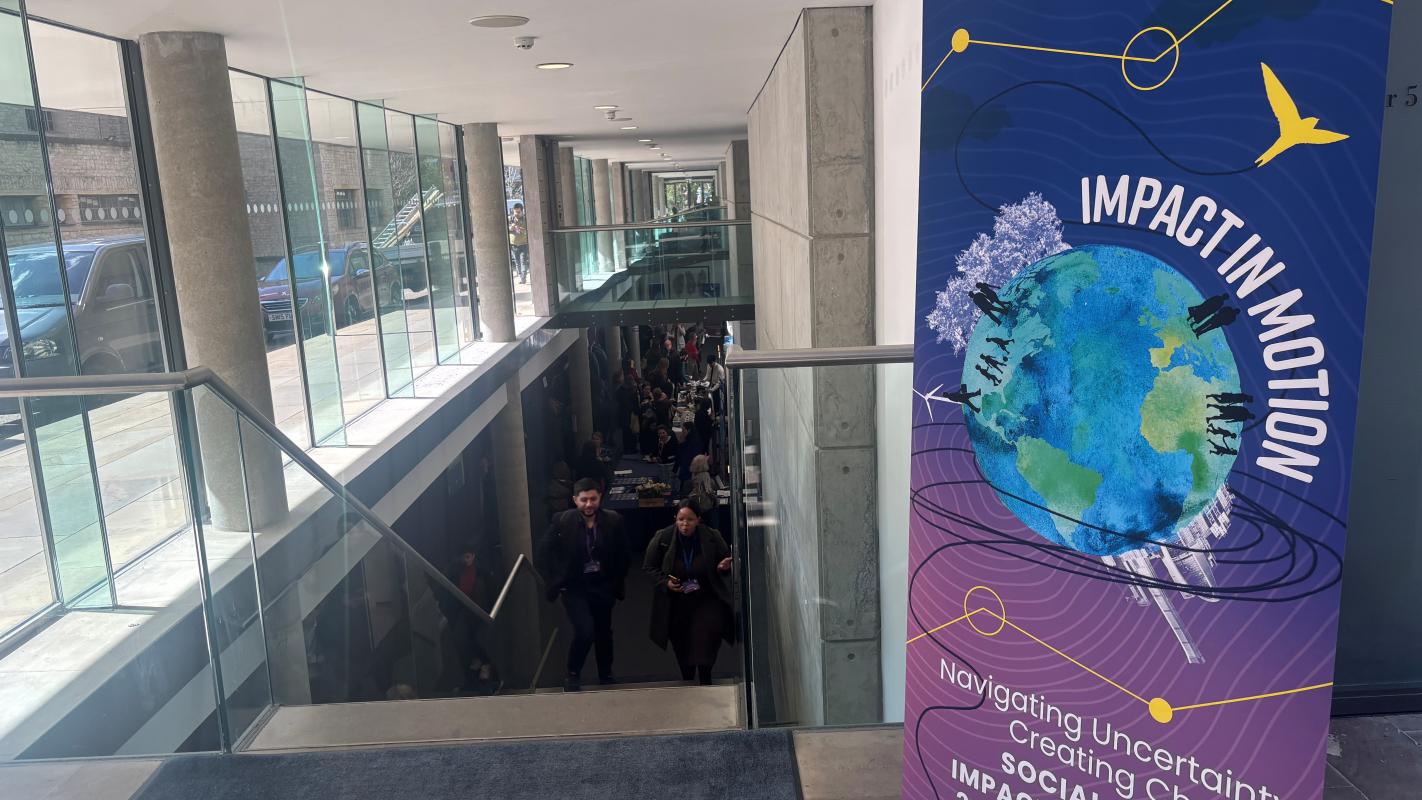
The 2026 Social Sciences Impact Conference, Impact in Motion: Navigating Uncertainty, Creating Change (24–25 March 2026), brought together more than 300 delegates, including social scientists from over 50 universities in the UK and internationally, alongside policymakers, funders, third sector organisations and business representatives.
Hosted by the University of Oxford's Social Sciences Division in collaboration with Oxford Brookes University and the Campaign for Social Science, the two-day event explored how the social sciences can deliver meaningful change in a rapidly evolving world. Through a mix of plenaries, panels and interactive workshops, participants shared practical examples, reflected on current challenges, and explored new approaches to research impact.
The conference opened with a panel featuring contributions from major funders, including ESRC and the British Academy, alongside speakers such as Professor Dame Julia Black, Warden of Nuffield College, and Will Hutton, President of the Academy of Social Sciences. The discussion explored the challenges and opportunities facing the social sciences in uncertain times.
Professor Irene Tracey, Vice-Chancellor of the University of Oxford, followed with an inspiring address, highlighting the power of storytelling as a tool for delivering impact. Reflecting on the conference, she said: 'The theme for this year’s Social Sciences Impact Conference couldn’t be more timely. We are living through a period of profound global challenge — from geopolitical instability and climate change to widening inequalities and rapid technological transformation. In such times, the social sciences are indispensable. They help us to understand the human dimensions of these challenges and to shape responses that are informed, inclusive and effective.
As a University, we are committed not only to advancing knowledge, but to ensuring that our research contributes meaningfully to society. By bringing together researchers, policymakers, practitioners and communities, the Social Sciences Impact Conference reflects our shared responsibility to translate insight into action — and to work together towards a more resilient, equitable and sustainable future.'
Professor Irene Tracey, Vice-ChancellorThe theme for this year’s Social Sciences Impact Conference couldn’t be more timely. We are living through a period of profound global challenge — from geopolitical instability and climate change to widening inequalities and rapid technological transformation. In such times, the social sciences are indispensable. They help us to understand the human dimensions of these challenges and to shape responses that are informed, inclusive and effective.
Additional highlights from the two-day programme included:
- Compelling plenary sessions exploring trust and credibility in the face of misinformation and polarisation, navigating the international research and aid landscape with purpose, empathy and imagination, and shaping the future of impactful social science research
- Powerful examples of researchers engaging with policymakers at national and international levels, as well as with local and regional government and devolved administrations
- Inspiring sessions showcasing creative and participatory approaches to engagement
- Sessions focused on collaborative partnerships to drive innovation
- A stimulating closing keynote from Professor Ngaire Woods, founding Dean of the Blavatnik School of Government, University of Oxford, highlighting the role universities can play in the age of AI in building human memory, knowledge and judgement
Alongside the main programme, the conference also featured a lively exhibition and a range of social activities.
Aileen Marshall-Brown, Head of Engagement, Social Sciences Division, University of Oxford and Event Lead, said: 'We were delighted to welcome so many delegates from a diverse range of professional backgrounds to Oxford, and we hope they left feeling inspired and energised. Throughout the conference, the social sciences were highlighted as essential not just in responding to the challenges we face in a rapidly changing world, but in helping to define them from the outset.
This means engaging early with funders, partners and researchers across disciplines. Together, they can shape how interdisciplinary collaborations work, ensuring that approaches to impact are creative, responsible and aligned with societal needs.'
Aileen Marshall-Brown, Head of Engagement, Social Sciences Division, University of Oxford and Event LeadThroughout the conference, the social sciences were highlighted as essential not just in responding to the challenges we face in a rapidly changing world, but in helping to define them from the outset.'
The conference was supported by Oxford’s ESRC Impact Acceleration Account; event partner the Campaign for Social Science; sponsors Overton and Palgrave Macmillan (part of Springer Nature); and reception sponsor Routledge, Taylor & Francis Group.
Recordings from selected sessions, along with interviews with speakers and participants and further insights from the conference, will be shared on the Social Sciences website in the coming weeks.